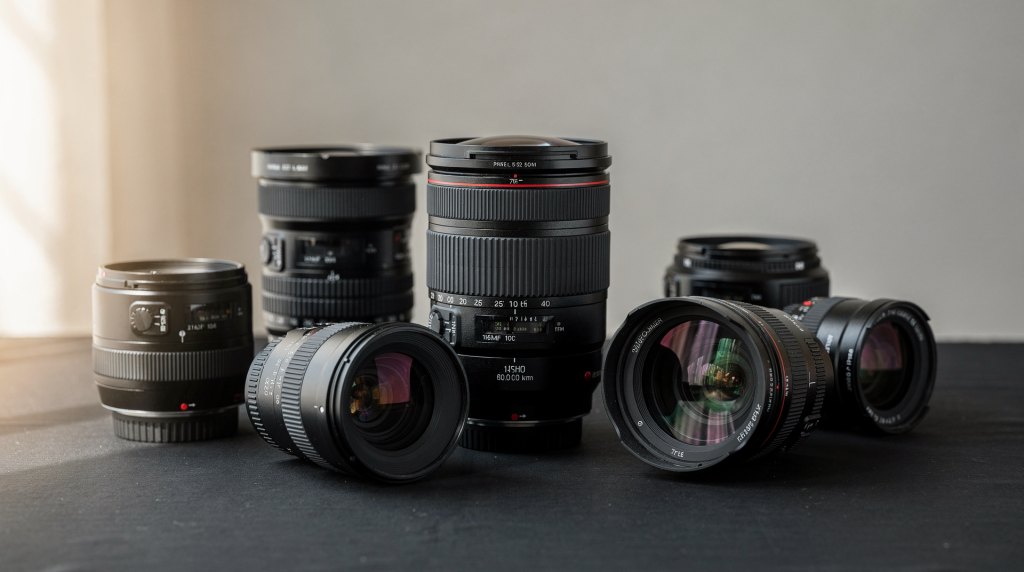
Choosing the best lenses for cinematic video production is less about owning the most expensive glass and more about matching focal length, speed, and lens character to the story you want to tell. For most filmmakers, the strongest starting point is a fast 35mm or 50mm prime, then a versatile zoom like 24-70mm f/2.8 for situations that demand speed and flexibility.
Why lens choice matters in cinematic video
A lens shapes three things that instantly change how a shot feels: framing, perspective, and depth of field. Wider lenses show more of the environment and exaggerate space, while longer lenses compress the background and make the subject feel more isolated.
For cinematic work, the goal is usually controlled, intentional image-making rather than convenience alone. That is why many filmmakers favor primes for narrative scenes and zooms for documentary, run-and-gun, or one-person production setups. When I moved from general video work into property and space marketing, this distinction became even sharper. In a real estate walkthrough, for example, a wide 24mm prime lets you show the full scale of a living room without the barrel distortion that makes walls bow outward — a subtle flaw that cheapens the final video. Meanwhile, an 85mm prime on a detail shot of kitchen fixtures or textured materials gives that soft, compressed background that signals quality to a buyer scrolling through listings. The lens isn’t just a tool; it’s the visual language the property speaks.
Prime lenses vs zoom lenses
Prime lenses have a fixed focal length. Zoom lenses cover a range, which makes them more flexible but often less specialized in look and handling.
| Lens type | Strengths | Weak points | Best use case |
|---|---|---|---|
| Prime lenses | Often sharper, wider apertures, shallower depth of field, more “cinematic” look | Less flexible on set | Narrative scenes, interviews, controlled lighting |
| Zoom lenses | Fast reframing, fewer lens swaps, practical for solo shooters | Usually less consistent aperture and character | Documentary, event work, small crews |
| Cine primes | T-stops, geared rings, consistent design across focal lengths | Higher cost | Professional productions, follow-focus setups |
| Anamorphic lenses | Wide cinematic frame, oval bokeh, horizontal flares | Expensive, more demanding to work with | Stylized narrative work |
In property videography, I’ve learned that the prime-versus-zoom decision often hinges on how much control you have over the space. When shooting a vacant luxury home with plenty of time, primes reward you with that crisp, dimensional look that makes rooms feel aspirational. But when you’re documenting an active commercial property with tenants moving through, a 24-70mm zoom becomes essential — you can reframe instantly without shuffling through a lens case while the light shifts. The trade-off is real: that zoom might not open to f/1.4, but it gets the shot before the moment passes.
The most useful focal lengths for cinematic video
24mm
A 24mm lens is a strong choice when you need to show a room, location, or environment without making the frame feel too distorted. It is useful for establishing shots, interiors, and movement-based scenes where the camera needs to feel present in the space. For real estate, this is often the workhorse focal length — wide enough to capture the flow from kitchen to dining area, but not so wide that the proportions look unnatural. I’ve found that positioning the camera at roughly chest height with a 24mm gives a natural eye line that helps buyers imagine themselves walking through the property.
35mm
A 35mm lens is one of the most common starting points for filmmakers because it balances subject emphasis with environmental context. It works well for dialogue, walking shots, interviews, and scenes where you want the subject to feel natural but still connected to the background. In property marketing, a 35mm is ideal for agent-to-camera segments or lifestyle shots where a family interacts in a furnished space — you see the people clearly, but the room still reads as part of the story.
50mm
A 50mm lens is often treated as the classic all-around cinematic focal length. It gives a natural-looking perspective and is frequently recommended as a first prime for filmmakers. When I shoot detail sequences — a row of pendant lights above an island, the texture of a stone backsplash — the 50mm delivers that slightly compressed, intimate feel without making the object feel disconnected from its surroundings. It’s the lens that sees the way the human eye sees, which makes it incredibly versatile for both wide and tight compositions when you have room to move.
85mm
An 85mm lens is ideal for close portraits, interviews, and compressed shots with soft background separation. It is especially useful when you want to isolate a subject and remove visual distractions. In the context of property videos, this focal length shines when you’re filming a developer or architect speaking about the project — the background melts away, and the viewer’s attention locks onto the person. It’s also excellent for capturing exterior details like balcony railings against a blurred cityscape, where the compression makes the scene feel polished and intentional.
24-70mm zoom
If you can only buy one lens for practical video work, a 24-70mm f/2.8 is hard to beat. It covers wide, normal, and short telephoto ranges, which makes it one of the most useful lenses for mixed production needs. For property walkthroughs, this single lens lets you grab a wide establishing shot of the facade, then zoom in smoothly to capture the front door hardware or landscaping details — all without changing glass. That speed matters when you’re shooting multiple properties in a day and the golden hour waits for no one.
What makes a lens feel “cinematic”
Fast aperture
A wide aperture such as f/1.4, f/1.8, or f/2 lets more light into the lens and creates shallow depth of field. That soft background separation is one of the most recognizable cinematic traits. In dimly lit interiors — think a moody restaurant space or a twilight exterior shot — a fast prime becomes not just a creative choice but a practical necessity. You can keep ISO lower and avoid the noise that creeps into shadows, which is critical when the final video needs to look clean on a large listing portal.
T-stops on cine lenses
Cinema lenses often use T-stops instead of f-stops. A T-stop measures how much light actually reaches the sensor, which makes exposure more consistent when swapping lenses. This might sound like a technical nuance, but when you’re cutting between a wide shot of a lobby and a close-up of a reception desk, consistent brightness across cuts keeps the edit seamless. F-stops are theoretical; T-stops are measured. That difference matters when you’re matching footage from multiple angles.
Manual control
Cine lenses usually include de-clicked aperture rings, hard focus stops, and geared rings for follow focus systems. These features matter because video depends on smooth, repeatable focus and exposure changes. During a slow push-in toward a property’s key feature — say, a fireplace or a view window — a de-clicked aperture lets you subtly adjust exposure without the jarring stepped brightness changes that still-photo lenses often produce. It’s one of those details that separates amateur footage from professional presentation.
Minimal focus breathing
Focus breathing is the visible change in framing when shifting focus. Good video lenses try to minimize it so focus pulls feel cleaner and less distracting. In a real estate video, you might rack focus from a foreground object like a vase to the view beyond the window. If the frame noticeably zooms in or out during that pull, the effect feels cheap and pulls the viewer out of the experience. Lenses designed with video in mind suppress this behavior, keeping the composition stable.
Best lens types by shooting scenario
| Scenario | Best lens choice | Why it works |
|---|---|---|
| Narrative short film | 35mm and 50mm primes | Balanced perspective and strong subject separation |
| Interview | 50mm or 85mm prime | Clean background compression and flattering facial rendering |
| Documentary | 24-70mm f/2.8 zoom | Fast repositioning and flexible framing |
| Interior or real estate video | 24mm to 35mm lens | Shows room scale while preserving shape and depth |
| Handheld run-and-gun | 24-70mm zoom | Fewer lens changes and easier coverage |
| Stylized commercial work | Anamorphic or cine prime set | Stronger visual identity and controlled optics |
Notice how the real estate row specifically calls out the 24mm to 35mm range. That’s not arbitrary. When I’m filming a property, the goal is to make rooms feel spacious without lying about their dimensions. A 24mm gives breathing room to a narrow hallway; a 35mm keeps a master bedroom looking generous but not cavernous. Push wider than 24mm and you risk the “funhouse mirror” effect where buyers walk in and feel misled. That trust is everything in this industry.
Practical buying guidance by budget
Beginner setup
Start with one fast prime, usually a 35mm or 50mm. That gives you enough flexibility to learn composition, blocking, and depth of field without overwhelming your workflow. For someone just getting into property video, a 35mm on a full-frame body is forgiving enough to shoot handheld walkthroughs while still delivering that shallow-focus look on detail shots.
Budget-conscious filmmaker
A small prime pair such as 35mm and 85mm gives a strong mix of practical coverage and cinematic look. Sources also point to affordable cine-style options such as Rokinon or Samyang-style primes for early projects. These manual-focus lenses force you to slow down and think about each shot, which builds good habits. I’ve seen agents produce remarkably polished listing videos with just these two focal lengths and careful attention to natural light.
Mid-level creator
A 24-70mm f/2.8 zoom plus one fast prime is often the smartest combination. The zoom handles coverage, while the prime gives you a more polished look for interviews or hero shots. For property work, this duo means you can walk through a home quickly with the zoom, then switch to the prime for the hero sequence — maybe a slow slider shot across the kitchen island at f/1.8 that becomes the thumbnail moment.
Advanced production
At higher levels, crews often mix cine primes, specialty zooms, and anamorphic lenses depending on the project’s visual language and budget. In those cases, lens choice is driven by the story, not just technical specs. When a luxury development hires you to create a brand film rather than a simple listing tour, the lens package becomes part of the creative brief — anamorphic for that wide, cinematic aspect ratio that suggests prestige, or a matched set of cine primes for consistent color and contrast across every scene.
What to check before you buy
- Mount compatibility with your camera body
- Full-frame vs APS-C coverage
- Maximum aperture
- Manual focus feel and focus throw
- Weight and balance on your rig
- Focus breathing performance
- Whether you need photo lenses or true cine lenses
- Filter thread size if you use matte boxes or ND filters
I’d add one more practical check from the field: test the lens in the kind of space you actually shoot. A lens that feels balanced on a gimbal in an open loft might become unwieldy in a tight bathroom or narrow staircase. Weight distribution matters more than absolute weight when you’re holding a rig for hours across multiple properties.
Common mistakes when choosing cinematic lenses
- Buying too wide too early and ending up with distorted faces or flat-looking interviews
- Chasing the lowest f-number without considering autofocus, focus breathing, or handling
- Buying a specialty lens before owning a reliable standard prime
- Ignoring sensor crop factor, which changes effective field of view
- Choosing a lens only for sharpness and forgetting that video depends heavily on motion, focus behavior, and consistency
I see the crop factor mistake often when photographers transition to video on APS-C bodies. That 24mm you loved for stills suddenly behaves like a 35mm, and your wide interior shots feel cramped. Always do the math before you invest. And the obsession with sharpness? Some of the most cinematic property videos I’ve seen were shot on older manual glass with character — slight edge softness that actually flatters interiors by smoothing harsh architectural lines.
Simple lens kits that make sense
Minimal kit
- 35mm prime
- 50mm prime
Flexible solo-creator kit
- 24-70mm f/2.8 zoom
- 85mm prime
Narrative-focused kit
- 24mm prime
- 35mm prime
- 50mm prime
- 85mm prime
Stylized premium kit
- Cine prime set
- One zoom for coverage
- Anamorphic lens for select hero shots
These kits aren’t theoretical — they’re built from watching what works in the field. The flexible solo-creator kit, for instance, is what I’d hand to an agent who wants to produce their own listing content. The zoom covers 90% of the walkthrough, and the 85mm gives them that one stunning hero shot that stops a scroll. The narrative kit is for the videographer who treats each property like a short film, where every room gets a deliberate focal length choice.
FAQ
What is the best single lens for cinematic video production?
A 35mm or 50mm prime is usually the best single starting lens because it offers a natural look and works across many scenes. If you’re filming properties, lean toward the 35mm — it’s wide enough for interiors without distortion, yet tight enough for detail shots when you move closer.
Are primes better than zooms for cinematic video?
Primes usually offer wider apertures and a more consistent “cinematic” feel, while zooms are better for speed and flexibility. The real answer depends on your shooting rhythm. If you have time to compose each shot deliberately, primes reward you. If you’re covering a busy open house or a dynamic commercial space, the zoom keeps you in the action.
Is a 24-70mm enough for filmmaking?
Yes, for many projects it is more than enough. It covers the focal lengths most creators use and is especially practical for documentary and general production work. In property marketing, a 24-70mm can be your only lens for months before you genuinely need something else.
Do I need cine lenses to make cinematic videos?
No. Many cinematic videos are shot on still-photo primes and zooms. Cine lenses mainly improve handling, exposure consistency, and focus control. The cinematic quality comes more from lighting, composition, and movement than from whether your lens has geared rings.
What focal length is most flattering for interviews?
An 85mm lens is often flattering for interviews because it compresses the background and keeps facial features looking natural. When filming an agent or developer testimonial in front of a property, the 85mm separates them from the building while keeping the context visible enough to matter.
Conclusion
The best lenses for cinematic video production are the ones that fit your shooting style, camera system, and workflow. For most creators, the smartest path is simple: start with a fast 35mm or 50mm prime, add a 24-70mm zoom for flexibility, and build toward specialty lenses only when a project genuinely needs them. In the world of property and space marketing, this approach keeps you nimble, keeps your kit manageable, and — most importantly — keeps the focus on the spaces you’re there to capture.