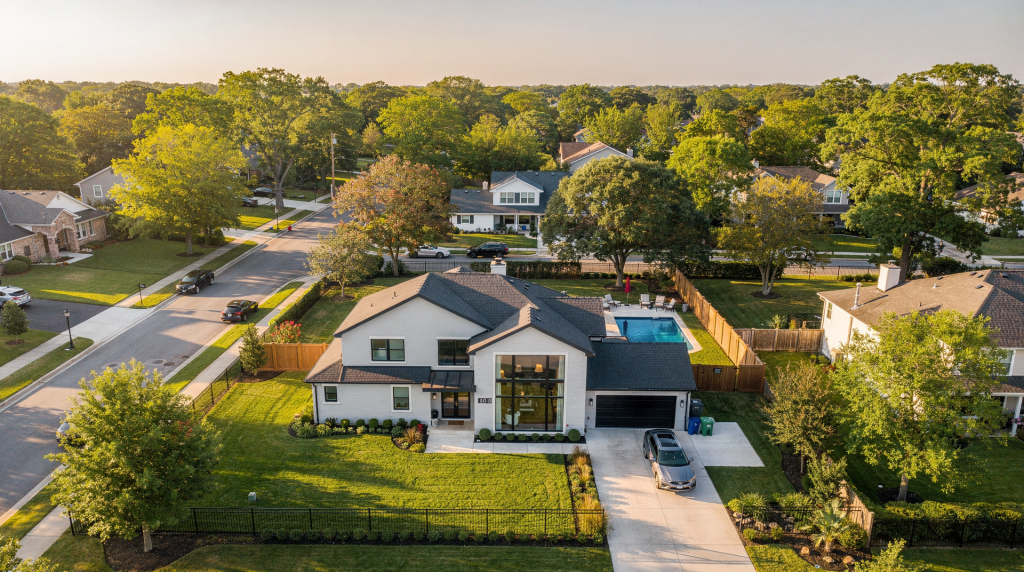
Drone footage can make a listing feel clear, spacious, and credible—but only if it shows what buyers actually care about. The best aerial videos do more than look cinematic: they answer practical questions about lot size, neighborhood context, roof condition, privacy, access, and outdoor features.
Why drone footage matters in real estate
A buyer usually wants orientation before aesthetics. A good aerial shot helps them understand:
- how big the property really is
- where the boundaries seem to sit
- what is next door
- how close the home is to roads, water, parks, or busy areas
- whether the roof, yard, driveway, pool, or outbuildings add value
That is why strong real estate drone footage feels informative first and stylish second. If the video does not help a buyer visualize the site, it is just decoration.
What buyers need to see from the air
1. The full property context
The first thing buyers need is the “big picture.” A wide aerial frame should show the house, yard, driveway, nearby structures, and enough surrounding context to understand the setting.
This is especially important for:
- larger lots
- homes near open land, water, or wooded areas
- properties with unusual shapes or setbacks
- homes where privacy is a selling point
- listings where neighborhood context affects value
A buyer should be able to answer, in one glance, “What am I actually buying?”
2. Lot size and boundaries
Drone footage is one of the clearest ways to show how much usable land comes with a property. Top-down or elevated angle shots can help communicate:
- approximate lot shape
- separation from neighboring homes
- backyard depth
- side-yard width
- placement of fences, trees, and accessory structures
If the lot feels larger than expected, aerial footage can create real confidence. If the lot is tighter than the photos suggest, drone footage prevents disappointment later.
3. Roof and exterior condition
Aerial footage can reveal details that ground-level photos often miss:
- roof lines and visible wear
- skylights, vents, chimneys, and solar panels
- gutters and drainage patterns
- exterior materials and symmetry
- signs of recent updates
For buyers, this is useful because it reduces uncertainty. For agents, it can support trust: the listing does not hide the parts that matter.
4. Outdoor lifestyle features
If the property has a pool, patio, deck, fire pit, tennis court, detached garage, barn, guest house, or landscaped yard, buyers should see how those features fit together.
Aerial footage is especially effective when it shows:
- how the backyard connects to the home
- whether outdoor spaces feel private
- how much room there is for entertaining
- how the main amenities relate to each other
This is where drone footage starts to sell a lifestyle, not just a structure.
5. Access, parking, and circulation
Buyers often want to know practical things that listing photos ignore:
- where visitors enter
- how the driveway connects to the street
- whether there is enough parking
- how easy it is to pull in and turn around
- how the garage sits relative to the home
These details matter more than many sellers realize, especially for rural homes, larger estates, multi-unit properties, or homes with unusual access roads.
The best drone shots for real estate
Below is a practical shot list that usually covers what buyers need without wasting time.
| Shot type | What it shows | Best use |
|---|---|---|
| Wide establishing shot | Home in context of land and neighborhood | Opening shot for orientation |
| Slow approach | The property as a buyer would “arrive” | Creates clarity and motion |
| Orbit shot | All sides of the home | Shows scale and symmetry |
| Top-down shot | Lot shape, boundaries, roof layout | Best for land and roof context |
| Reveal pull-back | Starts close, then opens to the full property | Strong closing shot |
| Backyard feature shot | Pool, patio, garden, or view | Highlights lifestyle amenities |
A simple drone video structure that works
Aerial footage should feel purposeful. A strong sequence usually follows this order:
Step 1: Open wide
Start with an elevated establishing shot that shows the property in its environment. Keep the camera movement slow and steady.
Step 2: Move toward the home
Use a gentle push-in or reveal so the viewer understands where the house sits on the lot.
Step 3: Show the surrounding context
Include one or two shots that clarify nearby roads, neighboring homes, trees, water, or open space.
Step 4: Focus on selling features
Give dedicated shots to the backyard, roof, pool, detached buildings, or standout exterior amenities.
Step 5: End with a memorable wide shot
Close with a pull-back or elevated view that leaves the buyer with a complete sense of the property.
What to avoid in real estate drone footage
Bad drone footage usually fails for one of these reasons:
- too much movement
- shots that are too short to understand
- flying just for drama instead of information
- showing the wrong side of the property first
- staying so high that the home feels tiny
- getting too close to neighboring homes without a reason
- editing the footage so heavily that the property looks misleading
The goal is clarity. If the shot looks impressive but does not explain anything, it is not doing its job.
Legal and safety basics buyers never see, but professionals must respect
Real estate drone footage is commercial work, so it must be handled accordingly. In the U.S., that generally means the operator should follow FAA Part 107 rules, including proper certification, registration, visual line of sight, and airspace compliance. Flying near airports or in controlled airspace may require authorization, and operations above the usual altitude limits are restricted except in narrow cases.
That matters because a listing video can be unusable if the flight was not legal or properly documented. It is worth confirming:
- who flew the drone
- whether the pilot is properly certified
- whether the drone is registered
- whether the area required airspace authorization
- whether the flight stayed within safe and legal limits
How to make drone footage more useful to buyers
Use the footage to answer buyer questions
Before you shoot, ask: what would a buyer want to know from above?
Common questions include:
- How big is the lot?
- How private is the backyard?
- What is next to the property?
- How is the roof condition?
- Where do cars park?
- How does the home sit on the land?
If a shot does not answer one of these, it may not be necessary.
Match the footage to the property type
Different properties need different aerial emphasis:
- suburban homes: lot layout, yard size, street position
- luxury homes: scale, privacy, landscaping, amenities
- rural homes: acreage, access roads, outbuildings
- waterfront homes: water proximity, view corridors, shoreline
- condos or townhomes: building context, parking, common areas
The same flight pattern does not work for every listing.
Keep the edit concise
Aerial videos should be focused. Buyers do not need three minutes of repetitive orbit shots. Shorter, cleaner edits hold attention better and make the property feel more deliberate.
Show real advantages, not just motion
The strongest aerial clips are useful even with the sound off. Buyers should understand the selling point in a few seconds.
If the footage cannot quickly explain why the property matters, cut it.
Common mistakes agents make with drone content
- using drone footage as a generic intro instead of a property explanation
- highlighting the wrong features first
- over-editing with filters or aggressive music
- ignoring weather and light, which can flatten the property
- using footage that makes distances or lot size feel inaccurate
- skipping the practical views that buyers actually need
Aerial content works best when it is specific. Generic drone movement is easy to forget.
Quick buyer-focused drone checklist
Use this checklist before publishing:
- Does the opening shot show the whole property in context?
- Does the video explain lot size or land use?
- Are the home’s best outdoor features visible?
- Can viewers understand parking and access?
- Does the footage show neighborhood or setting value?
- Is the roof or exterior condition visible where relevant?
- Is the edit short enough to keep attention?
- Does every shot add information?
When drone footage is worth it
Drone footage is most valuable when the property has one or more of these qualities:
- large or unusual lot size
- strong outdoor living spaces
- scenic setting
- visible roof or exterior features
- privacy as a selling point
- water, mountain, or skyline views
- acreage, outbuildings, or multiple structures
If the home is a small urban property with no exterior story, drone footage may still help—but only if it clarifies context instead of creating unnecessary cost.
FAQ
Do all real estate listings need drone footage?
No. Drone footage is most useful when the land, setting, or exterior features are a major part of the value.
How many aerial shots should a listing have?
Enough to answer the buyer’s main questions, usually just a few strong shots rather than many similar angles.
Should drone footage be used for every property type?
No. It works best for homes with clear outdoor value, useful context, or a setting that helps sell the property.
Is drone footage more important than interior video?
Usually no. Interior video shows layout and livability, while drone footage adds context and scale. The strongest listings use both.
What makes drone footage feel premium?
Slow movement, accurate framing, clean editing, and shots that clearly explain the property instead of just showcasing the drone.
Conclusion
Real estate drone footage should help buyers understand the property faster and more clearly. The best aerial content shows context, lot size, outdoor amenities, access, and features that cannot be seen from the ground. When used with purpose, drone video does more than make a listing look good—it makes the home easier to evaluate and easier to remember.